
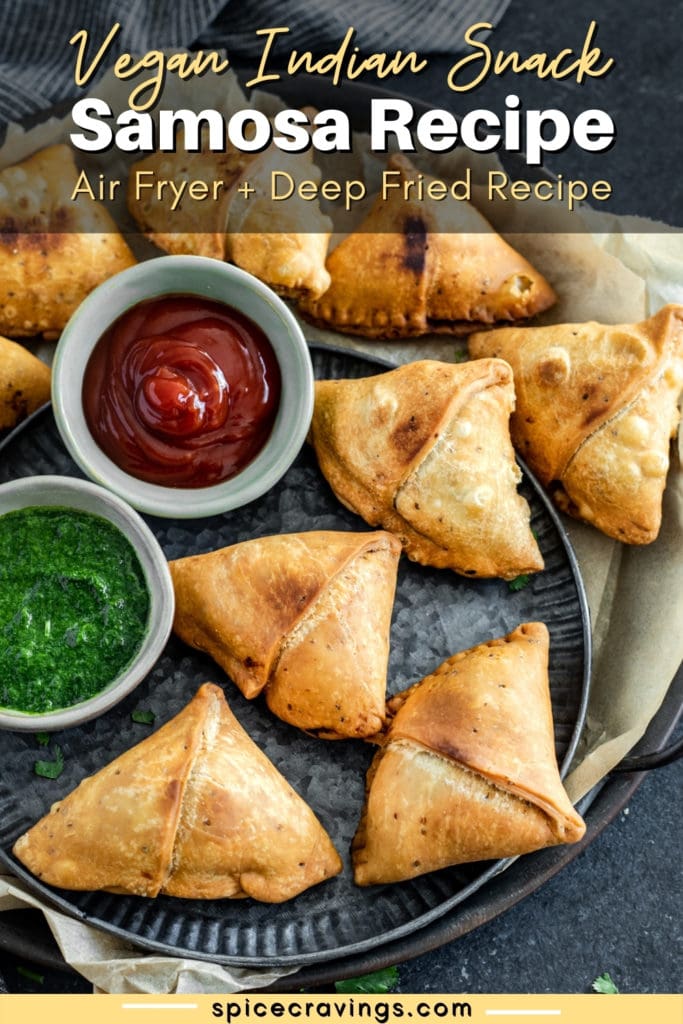
Sharing my best tips for aloo samosa recipe with step-by-step instructions for the perfect dough, filling, and folding technique. This traditional fried samosa is filled with spiced potatoes (aloo) and peas, and the crust has the iconic crispy and flaky texture. Enjoy it with chutney and a hot cup of tea!
Want to save this recipe?
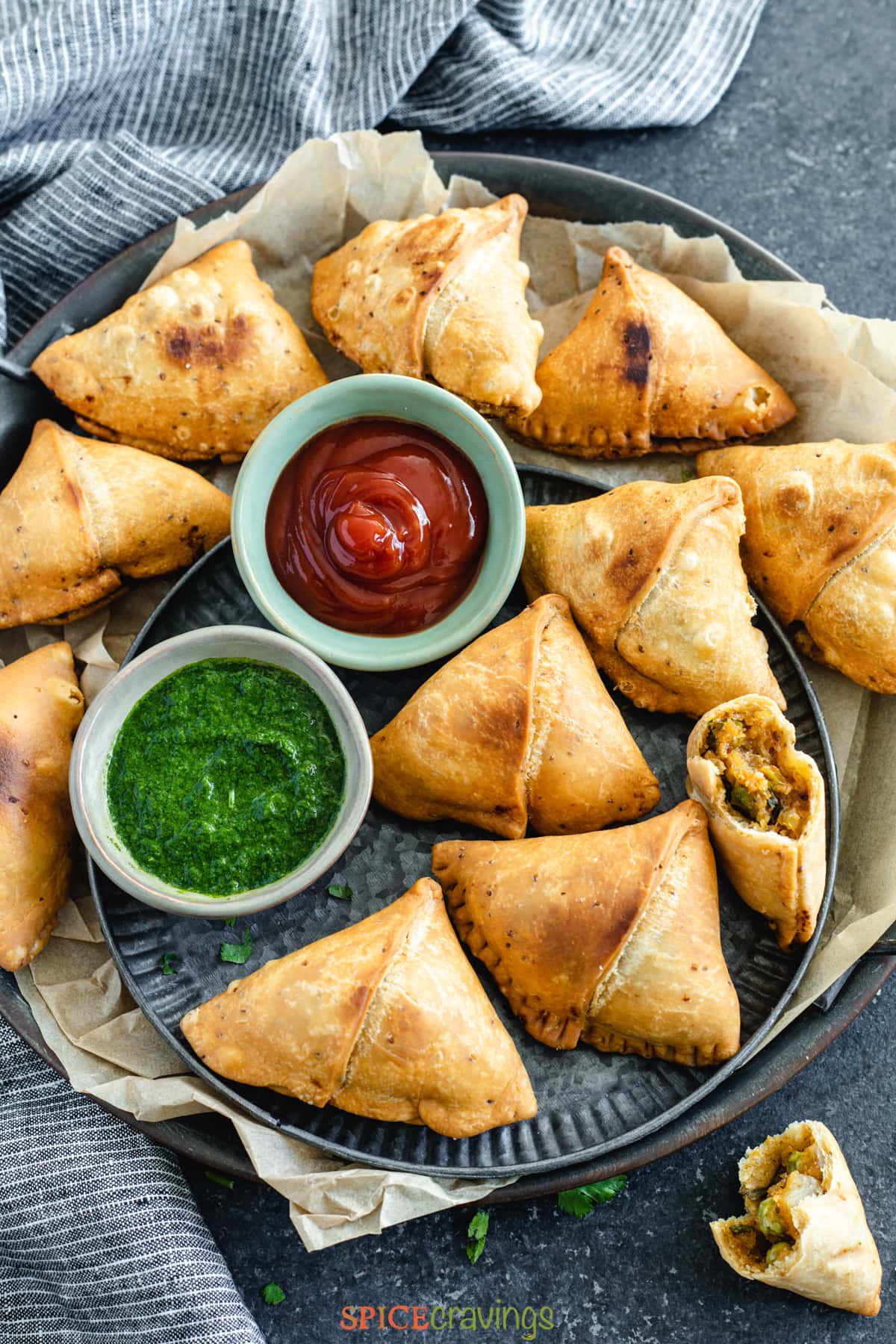
I am thrilled to share this simplified and failproof recipe for traditional fried aloo samosa with you. It's one of the most requested recipes by readers! I learned all these tips and tricks from my mother-in-law; she was truly the master of all Indian snacks.
If there were ever a quintessential Indian snack, it would undoubtedly be the samosa! Buttery thin pastry dough stuffed to the brim with spiced golden potatoes and green peas, then deep-fried, until it's golden brown and crisp!
Two components take a Samosa from great to excellent - a thin, crisp outer shell and a perfectly spiced filling. In this recipe, I will walk you through the steps to master both.
Tips & Tricks for Aloo Samosa: Don't be alarmed by the list of ingredients and steps. It's an easy snack to make that just takes a little time and patience. I recommend that you read through all the tips and tricks mentioned. I have experimented with this recipe multiple times, so you can make a fail-proof samosa in your first attempt.
What is Aloo Samosa?
A samosa is a deep-fried or baked pastry stuffed with a savory filling of spiced potatoes, peas, onions, cheese, lentils, or keema. Aloo samosa refers to the potato-stuffed samosas. The shapes can vary from triangular, cone, or half-moon, depending on the region.
Fun Fact: The samosa was originally named samsa after the pyramids of Central Asia, due to its traditional triangular or cone shape. Historical accounts also refer to it as sanbusak, sanbusaq, or sanbusaj, all of which derive from the Persian word sanbosag.
Ingredients - Notes & Substitutions
The ingredients can be broken down into three parts - samosa dough, samosa stuffing, and oil for cooking. Let's take a look at each one.
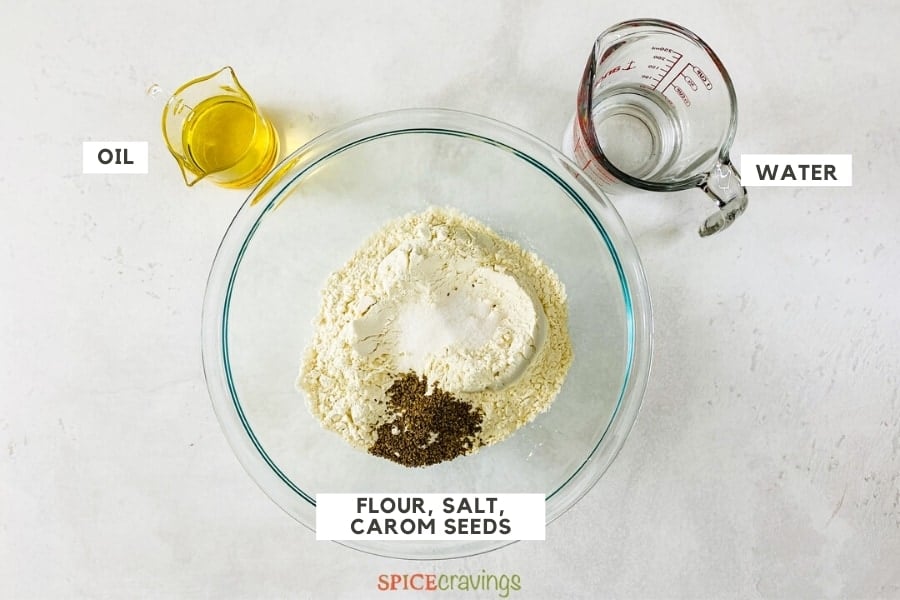
Samosa Dough Ingredients:
- All-Purpose Flour: Regular all-purpose flour, commonly referred to as Maida in Hindi, is all you need. I do not recommend whole wheat flour (atta) as the dough will be too dense. If you would like to make these a bit healthier, stick to an organic or unbleached, unbromated all-purpose flour.
- Carom Seeds (Ajwain): Carom seeds, or ajwain, have a taste that is similar to thyme, anise, and oregano. Look for them in Indian food markets, specialty spice shops, or online. If you cannot find them, substitute with cumin seeds.
- Avocado Oil: Avocado oil is a neutral-flavored oil with a high smoke point that binds the ingredients into a smooth dough.
- Cold Water: This ensures crisp results. I keep a cup of ice water ready and drizzle in 1 tablespoon of water at a time until the dough comes together.
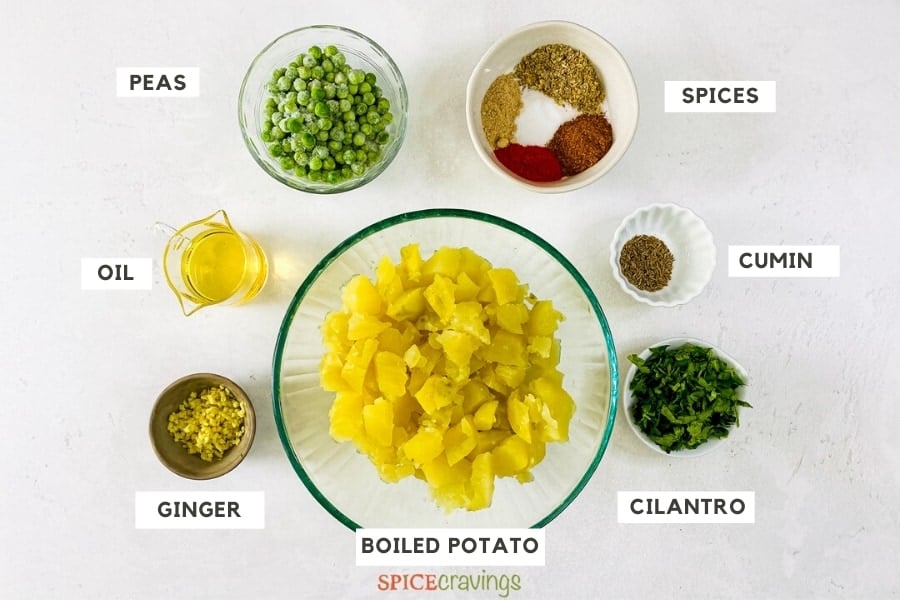
Filling Ingredients:
- Olive Oil: A few tablespoons of olive oil is a good starting point to potato samosas.
- Cumin Seeds: Add a nutty flavor and aroma.
- Ginger: I like to chop fresh ginger root rather than grate it finely. A 1-inch piece of ginger will yield approximately two teaspoons of chopped ginger.
- Garam Masala: This traditional and warmly scented Indian spice blend makes these samosas ultra-comforting. Use homemade garam masala or your favorite store-bought brand.
- Crushed Coriander Seeds: Lightly crush whole coriander seeds in a mortar and pestle or pulse them a few times in a spice grinder for an authentic texture and flavor. Coriander powder is a good substitute.
- Red Chili Powder: Cayenne or Kashmiri red chili powder (a flavor combo of paprika and cayenne) are both great options. Reduce to ¼ teaspoon for medium heat or omit for mild heat.
- Dry Mango Powder (Amchur): Amchur is a fruity spice powder made from dried, unripe green mangoes, and it has a slight citrusy flavor. It adds that extra special pop.
- Water: A few tablespoons of water prevent the spices from burning.
- Gold Potatoes: Yukon gold potatoes provide the best flavor and overall texture. If you want to get ahead, wash, peel, and boil potatoes 1-2 days ahead and store in an airtight container in the fridge.
- Green Peas: Frozen green peas are easy and convenient. Remove approx ¾ - 1 cup frozen green peas from the freezer while you make the dough and gather the rest of the ingredients.
- Cilantro: A fresh and green finishing touch!
Oil for Deep Frying:
- Avocado Oil or canola oil: I prefer avocado oil for its high smoke point.

Looking for a lighter version, try this: Air-Fried Samosas (Easier & Healthier)
How To Make Aloo Samosa
Here are the step-by-step instructions for an easy samosa recipe from scratch!
Knead Samosa Dough
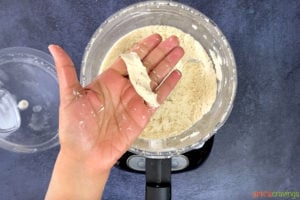
- Add flour, salt, and carom seeds to the food processor jar. Add oil while running the machine on low speed, until the flour absorbs the oil and looks crumbly. Alternatively, add the ingredients to a large bowl, add the oil, and rub with your fingers until it becomes crumbly (Pic 1).
- To check if the dough is ready for water, press a small portion between your palm and see if it holds its shape. If it falls apart, add another teaspoon of oil until it does. This step is called 'moyen' or 'moyan' in Hindi (Pic 2).
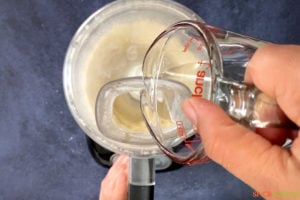
- Add water, a little at a time, and knead on low speed until a firm dough is formed. Scrape the sides of the bowl halfway through. It should take around 4-5 minutes for the dough to come together. If kneading by hand, knead until the dough ball comes together (Pic 3).
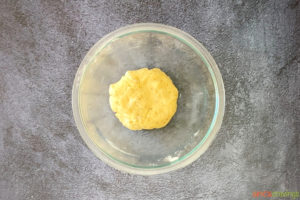
- Transfer the dough to a bowl and cover it with a damp kitchen towel to prevent it from drying and cracking. Rest it for 1 hour (Pic 4). Prepare the filling while the dough rests.

Make the Stuffing
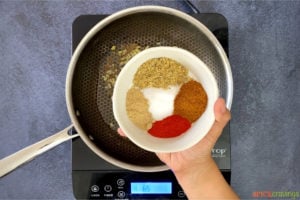
- Heat oil in a non-stick pan on medium-high heat. Add cumin seeds and saute until they sizzle. Add ginger and spices (Pic 5).
- Make sure to add 2-3 tablespoons water to prevent the spices from burning. Cook for 30 seconds while stirring (Pic 6).
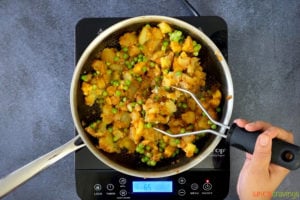
- Stir in chopped boiled potatoes, and gently crush them using your spatula or a potato masher. Stir in peas and cook for another 2 minutes (Pic 7).
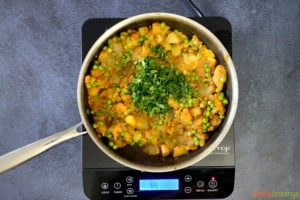
- Adjust seasoning to taste. Add chopped cilantro and turn off the heat (Pic 8).

Shape, Stuff, & Fold Samosa
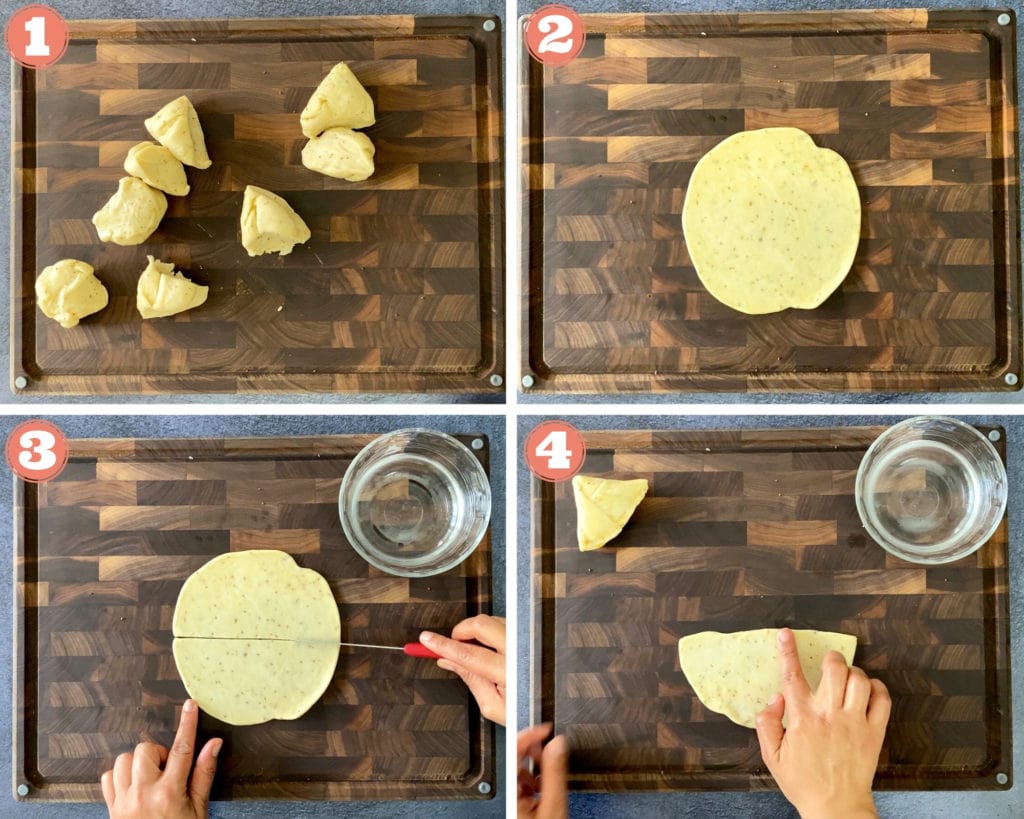
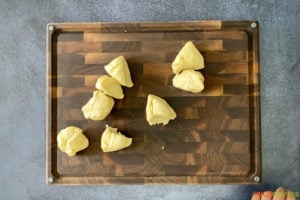
- Give the dough another quick knead for 30 seconds. Now divide the dough into 8 portions and roll each one into a smooth ball. Cover the dough balls with a damp kitchen towel to prevent drying (Pic 1).
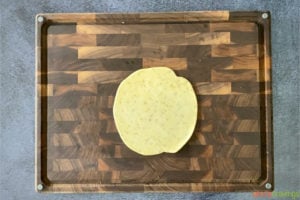
- Place a dough ball on a flat surface. Add a few drops of oil on each side of the dough ball and roll it into an evenly thick 6-inch disc using a rolling pin. The thickness of the dough should be about 1/16th inch (Pic 2).
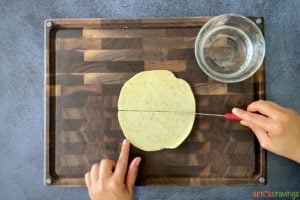
- Cut the disc in half to form two semi-circles. Place one semi-circle with the rounded edge facing you (Pic 3).
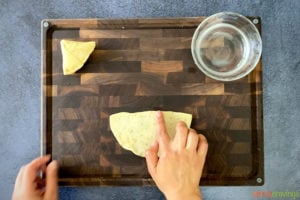
- Apply water on the left-half straight edge of the semi circle (Pic 4).
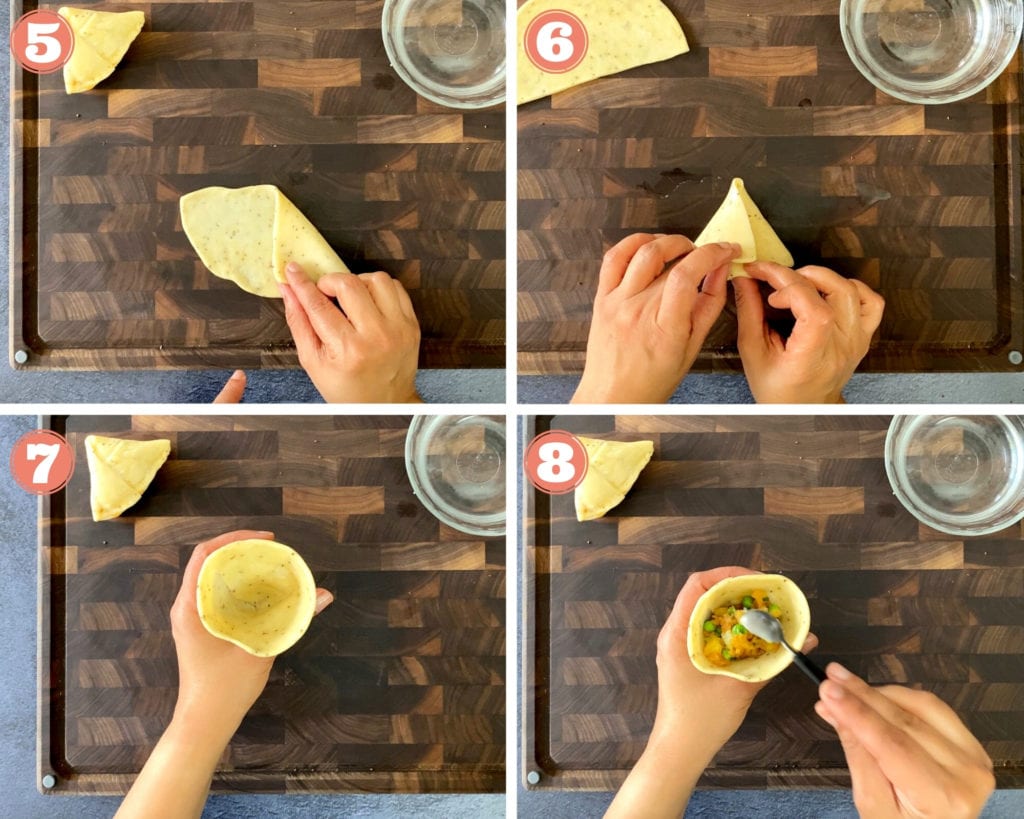
- Lift the right edge of the semicircle and bring it down to the center of the semicircle while holding it (Pic 5).
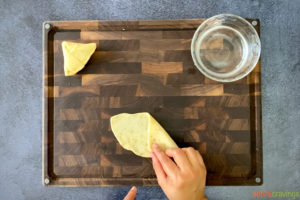
- Now bring the other edge of the semicircle (wet side) to the center, overlapping the two edges (Pic 6).
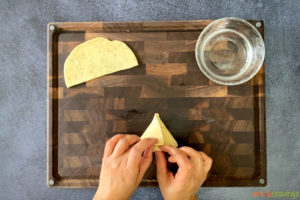
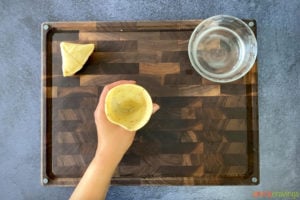
- Gently press to seal both sides together to form a cone. Pinch the tip to seal well. Hold the cone upright in your hand (Pic 7).
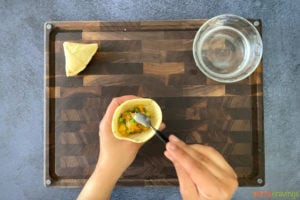
- Add two tablespoons of the filling in the center (Pic 8).
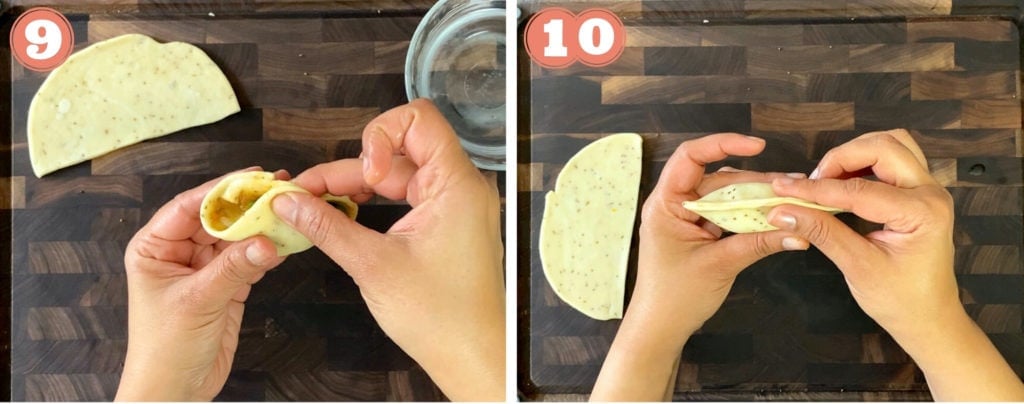
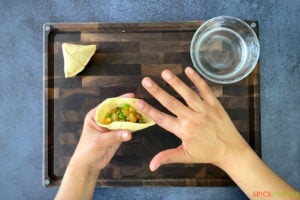
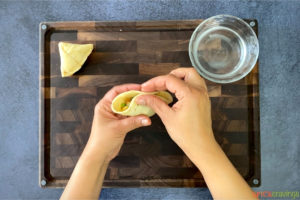
- Apply water on the inner side of the open edges of the cone. Holding from the middle, gently bring the open seams towards the center, pinching them together to seal them (Pic 9).
- Ensure that the samosa is sealed all the way through. Form all samosas using this method (Pic 10).
How to Fry Samosa
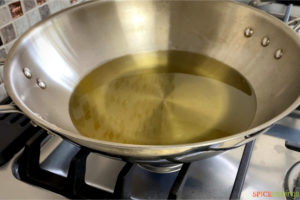
- Heat 2 cups of canola or vegetable oil in a heavy-bottomed wok over medium-low heat for about 12-15 minutes.
- To confirm if the oil is the right temperature, drop a small crumble of the dough into the oil. If multiple tiny bubbles start forming around the dough, the oil is ready. If it floats to the top immediately, reduce the heat and wait for the oil to cool slightly.
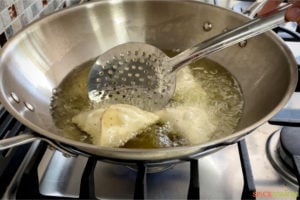
- Place a samosa on the ladle and slide it carefully into the hot oil. Repeat with 3 more samosas, being careful not to overcrowd the wok.
- Fry for about 15-18 minutes on medium-low heat, flipping the samosa 2-3 times, until it turns golden in color. Remove the samosas and transfer them onto a kitchen towel-lined plate to absorb the excess oil. Fry the remaining samosas.

Serving Suggestions
I love to make these for my family as a mid-afternoon snack or an appetizer for weekend festivities. My girls enjoy them as an after-school treat with a combination of tamarind chutney and green chutney.
For an ideal pairing, serve them alongside a hot cup of Masala chai or Ginger tea.
They are a very special treat during the month of Diwali, Holi, and Ramadan, too. You can always prepare them ahead of time and freeze them, then serve according to instructions on the day of the celebration.

Freezer Instructions
One of my favorite aspects of making samosas at home is that they are extremely freezer-friendly. I assemble the samosas up to the stuffing and sealing stage.
Once the samosas are tightly sealed, I place them in one even layer on a parchment-lined baking sheet and freeze for 1 hour.
Then, transfer them to a plastic freezer storage bag, seal it tightly, label it, date it, and freeze for up to 3 months.
Recipe Tips & Notes
Dough Making Tips:
- After adding oil to the dough, mix it until it resembles coarse sand. To check if it's ready for water, press it together between your palm and see if it holds its shape. If it falls apart, add another teaspoon of oil until it does.
- Add cold water to the dough to achieve a crisp crust.
- Rest the dough for one hour. I tried two batches with rest times of 30 minutes and 45 minutes, respectively, and neither performed as well as the dough that was rested for an hour.
- Cover the dough with a wet kitchen towel while resting to prevent it from drying and cracking.
Rolling Tips:
- For a smoother rolling experience, add a few drops of oil on the dough ball before you start rolling.
- Roll on a wooden cutting board as opposed to a smooth countertop. The added texture in the wooden board makes rolling this stretchy dough easier.
- Roll them evenly. To ensure even cooking and crisping, roll the dough into an even thin layer. Remember, thin dough = crisp crust. The shape should be round or oval. Don't worry if it's not a perfect circle.
Samosa Folding Tips:
- When using water to seal the edges, use only a small amount. Excess water can make it harder to seal.
- When overlapping the two rounded edges, make sure to overlap at least ½-inch. That prevents the dough from splitting open when frying or air frying.
- Use cooled filling to stuff the samosas. Warm filling will loosen the fat in the dough and prevent it from crisping up.
Samosa Cooking Tips:
- Perform the dough test as mentioned in the recipe steps to ensure the oil is at the correct temperature for deep-frying. If the oil is too hot, the samosas will brown on the outside while remaining undercooked on the inside. If the oil is too cold, they will absorb excess oil and be greasy.
Looking for an air fryer recipe? Check out Air-Fried Samosa Recipe
Easy Samosa Recipe FAQs
Using too little oil in the dough will result in hard samosas.
Adding too much water to the dough will result in an oily crust. Another reason can be that you added them to the pan when the hot was not hot enough.
Certainly! Preheat the oven to 375°F. Line a baking sheet with aluminum foil. Brush the samosas generously with oil. Place them on the baking sheet, leaving about 1 inch of space between each. Bake for 25-30 minutes. After about 15 minutes, flip them and brush with a little more oil. Bake until golden brown.
More Samosa-Inspired Recipes on the Blog
You may also like: Indian Dinner Party Menu Ideas
📖 Recipe

Aloo Samosa Recipe (Fried)
Want to save this recipe?
Video
Equipment
- Stainless Steel Wok or Kadai
Ingredients
For Samosa Dough
- 2 cups all purpose flour (maida)
- ¾ teaspoon salt
- 1 teaspoon carom seeds (ajwain)
- 5 tablespoons avocado oil
- 6 tablespoons cold water or as needed
For Samosa Stuffing
- 1 tablespoon olive oil
- 1 teaspoon cumin seeds
- 2 teaspoons ginger finely chopped
- 1 teaspoon salt adjust to taste after cooking
- 1 teaspoon garam masala
- 1 tablespoon crushed coriander seeds or ground coriander
- ½ teaspoon red chili powder (cayenne) reduce to ¼ teaspoon or skip for mild
- ½ teaspoon dry mango powder amchur
- 2-3 tablespoons water
- 3 medium gold potatoes boiled and chopped
- ¾-1 cup green peas thawed, adjust to your liking
- 3 tablespoons cilantro finely chopped
Oil for Deep Frying Samosas
- 2 cups canola or avocado oil
Instructions
Knead Samosa Dough
- Add flour, salt and carom seeds to the food processor jar. Add oil while running the machine on low speed, until the flour absorbs the oil and looks crumbly. Alternatively, add the ingredients to a large bowl, add oil and rub with your fingers till it gets crumbly.

- To check if the dough is ready for water, press a small portion between your palm and see if it holds shape. If it falls apart, add another teaspoon of oil until it does.
- Add water, a little at a time, and knead on low speed until a firm dough is formed. Scrape the sides of the bowl half way through. It should take around 4-5 minutes for the dough to come together. If kneading by hand, knead until the dough ball comes together.
- Transfer the dough to a bowl and cover it with a damp kitchen towel to prevent it from drying and cracking. Rest it for 1 hour. Prepare the filling while the dough rests.
Make the Stuffing
- Heat oil in a non-stick pan on medium-high heat. Add cumin seeds and saute until they sizzle. Add ginger and spices. Make sure to add 2-3 tablespoons water to prevent the spices from burning. Cook for 30 seconds while stirring.
- Stir in chopped boiled potatoes, and gently crush them using your spatula or a potato masher. Stir in peas and cook for another 2 minutes.
- Adjust seasoning to taste. Add chopped cilantro and turn off the heat.
Shape, Stuff, and Fold Samosa
- Give the dough another quick knead for 30 seconds. Now divide the dough into 8 portions and roll each one into a smooth ball. Cover the dough balls with a damp kitchen towel to prevent drying.
- Place a dough ball on a flat surface. Add a few drops of oil on each side of the dough ball and roll it into an evenly thick 6-inch disc using a rolling pin. The thickness of the dough should be about 1/16th inch.
- Cut the disc in half to form two semi-circles. Place one semi-circle with the rounded edge facing you.
- Apply water on the left-half straight edge of the semi circle.
- Lift the right edge of the semi-circle and bring it down to the center of the semicircle while holding it.
- Now bring the other edge of the semicircle (wet side) to the center, overlapping the two edges.
- Gently press to seal both sides together to form a cone. Pinch the tip to seal well. Hold the cone upright in your hand.
- Add 2 tablespoons of the filling in the center.
- Apply water on the inner side of the open edges of the cone. Holding from the middle, gently bring the open seams towards the center, pinching them together to seal them.
- Ensure that the samosa is sealed all the way through. Form all samosas using this method.
Fry Samosas
- Heat 2 cups canola or vegetable oil in a heavy bottom wok on medium-low heat for about 15 minutes. To confirm if the oil is the right temperature, drop a small crumble of the dough into the oil. If multiple tiny bubbles start forming around the dough, the oil is ready. If it floats to the top immediately, reduce the heat and wait for the oil to cool down a bit.
- Place a samosa on the ladle and slide it in to the hot oil carefully. Repeat with 3 more samosas, without overcrowding the wok. Fry for about 15-18 minutes on medium-low heat, flipping 2-3 times, until the samosa turns golden in color. Remove samosas and transfer on to a kitchen towel lined plate to absorb the excess oil. Fry the remaining samosas by following this process.
Notes
Dough Making Tips:
- After adding oil to the dough, mix it until it resembles coarse sand. To check if it's ready for water, press it together between your palm and see if it holds shape. If it falls apart, add another teaspoon of oil until it does. This step is called 'moyen or moyan' in Hindi.
- Add cold water to make the dough to achieve a crisp crust.
- Rest the dough for one hour. I tried two batches with a rest time of 30 minutes and 45 minutes respectively, and both didn't work as well the dough that was rested for an hour.
- Cover the dough with a wet kitchen towel while resting to prevent it from drying and cracking.
Rolling Tips:
- For a smoother rolling experience, add a few drops of oil on the dough ball before you start rolling.
- Roll on a wooden cutting board as opposed to a smooth counter-top. The added texture in the wooden board makes rolling this stretchy dough easier.
- Roll them evenly. To ensure even cooking and crisping, roll the dough into an even thickness. The shape should be round or oval. Don't worry if it's not a perfect circle.
Samosa Folding Tips:
- When using water to seal the edges, use very little. Excess water can make it harder to seal.
- When overlapping the two rounded edges, make sure to overlap at least ½-inch. That prevents the dough from opening when frying or air frying.
- Use cooled filling to stuff the samosas. Warm filling will loosen the fat in the dough and prevent it from crisping up.
Samosa Cooking Tips:
- Perform the dough test as mentioned in the recipe steps to ensure that the oil is at the right temperature for deep frying. If the oil is too hot, samosas will brown while being undercooked on the inside. If the oil is too cold, they will absorb excess oil and be greasy.


Les says
I'm looking forward to trying this recipe on an upcoming vacay with friends. We'll get an assembly line going. I don't expect leftovers to be a problem. 😉
I sometimes make samosa-inspired potato skins (with russet potatoes) when my hubby decides he needs to avoid wheat. But he doesn't think much of my recipe's spice blend--yours sounds /much more interesting. And imli and mint chutney dipping sauces should take them over the top!
Aneesha says
I love the sound of a potato-skin varation- gotta try that! I hope you enjoy this recipe with your friends!
PB says
I did a trial run of making these and they are delicious.
For freezing, is it okay to stuff and seal them and then freeze them?
Thanks
Aneesha says
Hi PB, thanks a lot, I'm glad you enjoyed them. Yes, you can stuff and seal them, then freeze as per directions. Make sure to freeze such that they're not touching each other. After they're frozen, you can stack them together if you like.